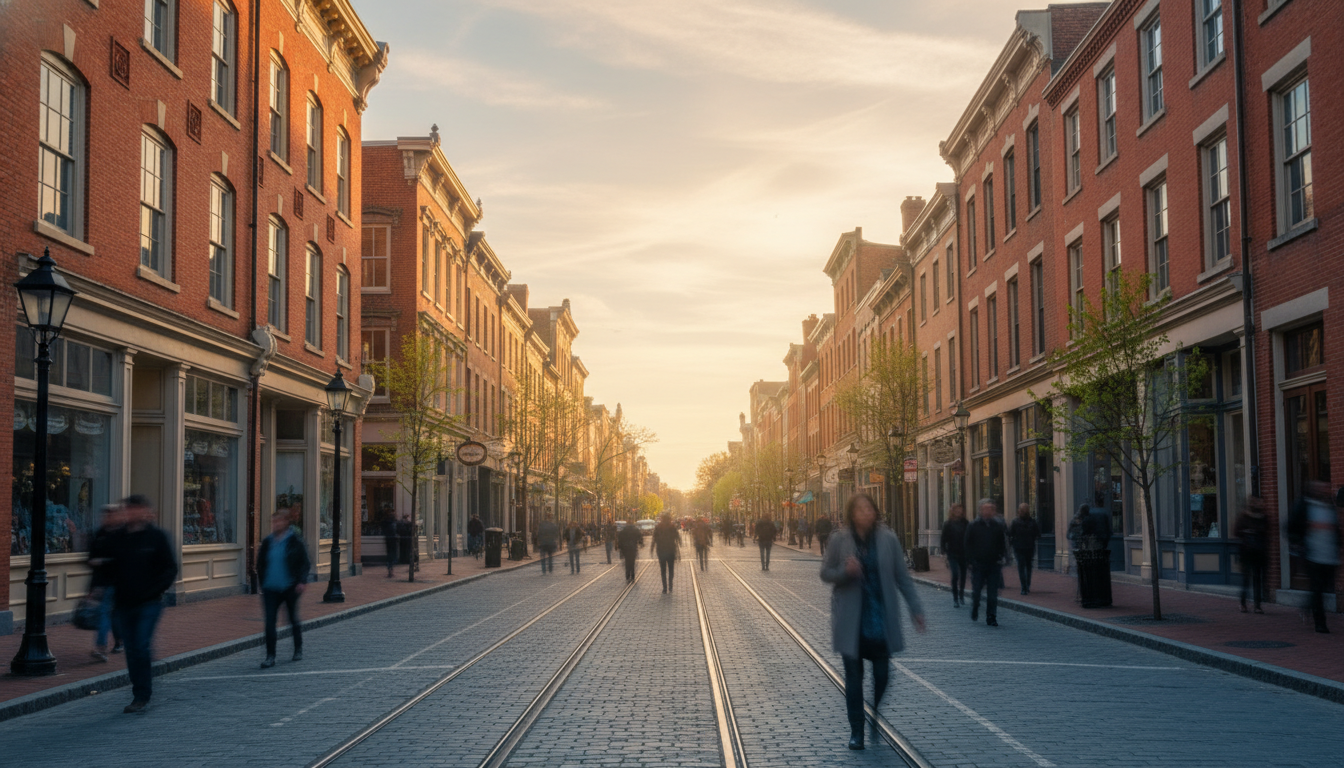
Historic Downtown Frederick Walking Tour
Best Preserved Downtown in Maryland
Frederick's 50-block historic district contains the state's largest collection of 18th and 19th-century architecture. The National Trust for Historic Preservation recognized Frederick as one of America's Dozen Distinctive Destinations.
Frederick's historic district invites exploration on foot through 50 blocks of preserved 18th and 19th-century architecture. This self-guided walking tour visits 12 significant stops spanning colonial history, the Civil War era, and Frederick's industrial past. The compact downtown layout makes navigation intuitive while delivering one of America's most distinctive historic experiences.
Walking Tour Route Overview
The tour begins at the Visitor Center and follows a logical loop through downtown's most significant historic sites. Total walking distance measures approximately 1.5 miles on relatively flat terrain. The route utilizes Frederick's brick-paved sidewalks and pedestrian-friendly street crossings. Allow 2-3 hours depending on your pace and interest in detailed exploration.
Starting Point
Begin at the Frederick Visitor Center located at 151 South East Street. The center occupies a restored 1890s freight warehouse providing an appropriate architectural introduction. Pick up printed walking tour maps and browse exhibits on Frederick history before departing. Free parking available in the adjacent lot for three hours.
Tour Stops: Historic Sites & Landmarks
Carroll Creek Linear Park
📍 Between South Street and East Street
Carroll Creek Park transformed Frederick's downtown from a flood-prone waterway into a vibrant urban park. The 1.3-mile creek walk features the iconic "Community Bridge" painted with trompe-l'œil art depicting historical scenes. The project won national recognition for urban flood control and downtown revitalization. Today, restaurants downtown Frederick line the creek with outdoor seating overlooking the water.
Historical Significance: The 1976 flood caused $18 million in damage, prompting the innovative creek culvert project that created this urban amenity while controlling flooding.
Delaplaine Arts Center
📍 40 South Carroll Street
The Delaplaine Arts Center occupies a restored 1912 grain mill on the Carroll Creek shore. The building represents Frederick's agricultural heritage as a regional grain processing center. Today, the nonprofit arts center provides galleries, classrooms, and studios serving over 100,000 visitors annually. The brick industrial architecture exemplifies adaptive reuse of historic structures.
Historical Significance: The mill operated for 60 years, processing grain from surrounding farms before closing in the 1970s. The conversion to arts use began in 1986.
Francis Scott Key Memorial
📍 114 West Church Street
The memorial honors Frederick's most famous native, Francis Scott Key, author of "The Star-Spangled Banner." The 1898 bronze statue depicts Key as a young lawyer. Key was born on a nearby farm in 1779 and practiced law in Frederick before moving to Georgetown. The memorial plaza provides a contemplative space honoring the national anthem's creation.
Historical Significance: Key wrote the anthem's lyrics during the War of 1812 after witnessing the British bombardment of Fort McHenry in Baltimore Harbor.
All Saints Episcopal Church
📍 106 West Church Street
All Saints Church anchors the "Clustered Spires" skyline that defines Frederick's historic silhouette. The current Gothic Revival structure dates to 1855, replacing earlier church buildings on the site. The 180-foot spire ranks among the tallest in the city. The churchyard contains graves dating to the 18th century including Revolutionary War veterans.
Historical Significance: During the Civil War, the church served as a hospital following the battles of Antietam and Gettysburg.
Evangelical Lutheran Church
📍 31 East Church Street
The Evangelical Lutheran Church contributes its distinctive spire to Frederick's famous skyline. Built in 1855, the church represents German Lutheran immigration to Frederick County. The congregation dates to 1733, making it one of Frederick's oldest continuous religious communities. The building's Gothic architecture features detailed stonework and stained glass windows.
Historical Significance: The church served as a field hospital during the Civil War, treating wounded from nearby battles.
Roger Brooke Taney House
📍 121 South Bentz Street
The restored home of Roger Brooke Taney, fifth Chief Justice of the Supreme Court, offers insight into 19th-century legal and domestic life. Taney is best known for the controversial Dred Scott decision. The house features period furnishings and exhibits on Taney's complex legacy. The property includes a reconstructed slave quarters acknowledging the enslaved people who lived and worked there.
Historical Significance: Taney served as Chief Justice from 1836 to 1864, the second-longest tenure in Supreme Court history.
Barbara Fritchie House
📍 154 West Patrick Street
The Barbara Fritchie House commemorates the Unionist patriot immortalized in John Greenleaf Whittier's poem. According to legend, Fritchie waved the American flag at Confederate troops passing her home in 1862. While historians debate the story's accuracy, the house represents Civil War divided loyalties in border-state Maryland. The reconstructed house contains period furnishings and Fritchie memorabilia.
Historical Significance: Whittier's 1864 poem made Fritchie a national symbol of Union patriotism, though she was 95 years old at the time of the alleged incident.
Hessian Barracks
📍 101 Clarke Place
The Hessian Barracks represent Frederick's longest-standing military connection. Built in 1777 to house British prisoners from the Battles of Saratoga, the stone structure later served as an armory, military school, and Civil War hospital. The barracks represent the only surviving military building from the Revolutionary War era in Maryland. The site now hosts the Maryland School for the Deaf.
Historical Significance: Over 4,000 British and Hessian prisoners occupied Frederick between 1777 and 1783, significantly impacting the local economy.
Frederick City Hall
📍 101 North Court Street
Frederick City Hall occupies a magnificent 1862 Italianate building originally constructed as the Frederick County Courthouse. The architecturally significant structure features a prominent clock tower and elaborate cornice details. The building served as a hospital during the Civil War and witnessed the 1864 ransoming of Frederick by Confederate forces. The interior retains original courtroom features.
Historical Significance: In 1864, Confederate General Jubal Early demanded and received $200,000 from Frederick to spare the city from destruction.
B&O Railroad Bridge
📍 Carroll Street at the railroad tracks
The Baltimore and Ohio Railroad bridge marks Frederick's industrial transportation history. Built in 1831 as part of America's first commercial railroad, the stone arch bridge carried passengers and freight through downtown. The bridge's continued use by CSX Transportation demonstrates the enduring importance of rail to Frederick's economy. The structure represents early American railroad engineering.
Historical Significance: The B&O Railroad was the nation's first common carrier railroad, connecting Baltimore to the Ohio River and western markets.
Frederick County Courthouse
📍 100 West Patrick Street
The current Frederick County Courthouse dates to 1862, replacing the earlier courthouse now serving as City Hall. The impressive Greek Revival structure anchors the historic courthouse square. The building continues serving judicial functions while representing legal continuity since Frederick's founding. The courthouse lawn hosts community events and serves as a gathering space.
Historical Significance: The courthouse square has been the center of Frederick's civic life since the town's founding in 1745.
Historic District Market Street
📍 Market Street between Patrick and 6th Street
Market Street forms the commercial heart of Frederick's historic district. The streetscape preserves 19th-century storefronts housing restaurants downtown Frederick, boutiques, and galleries. Architectural styles range from Federal to Victorian, showcasing the city's commercial evolution. The street's width follows colonial town planning principles allowing for markets and public gatherings. Weekend visitors enjoy street performers and outdoor dining.
Historical Significance: Market Street follows the original 1745 town plan, maintaining the same width and alignment for nearly 280 years.
Architectural Styles Guide
Frederick's historic district displays a remarkable range of American architectural styles spanning three centuries. Understanding these styles enhances appreciation of the buildings encountered on the walking tour. Look for these distinctive features as you explore.
Federal Style (1780-1830)
Federal architecture reflects early American ideals through symmetrical designs and classical details. Look for brick construction, elliptical fanlights above doors, and delicate decorative moldings. Windows typically align in regular patterns across facades. Many of Frederick's earliest commercial buildings on Patrick Street display Federal characteristics.
Greek Revival (1830-1860)
Greek Revival buildings reference ancient democracy through temple-like forms. Identifying features include prominent columns, pediments above doorways, and heavy cornices. The Frederick County Courthouse exemplifies this style with its columned portico. Religious buildings often adopted Greek Revival designs during this period.
Italianate (1840-1885)
Italianate architecture brings romantic European influences to American cities. Look for bracketed cornices, tall narrow windows, and low-pitched roofs. Many Market Street commercial buildings feature Italianate storefronts with decorative window hoods. The style signals Frederick's mid-19th-century prosperity.
Dining Along the Route
Historic walking works up an appetite fortunately satisfied by restaurants downtown Frederick offers throughout the district. These dining options complement the tour with historic ambiance and local cuisine.
Treaty of Paris
Located in the historic Carroll Creek warehouse district, Treaty of Paris serves upscale American cuisine in a building dating to 1833. The restaurant's name references the 1783 treaty ending the Revolutionary War. Outdoor seating overlooks Carroll Creek's water features and public art.
Brewer's Alley
Maryland's first brewpub occupies a restored 1860s building on Market Street. The brewery produces award-winning beers on-site while the restaurant serves pub fare. The historic interior retains exposed brick and timber framing. The rooftop deck provides views of the Clustered Spires.
Frederick Farmers Market
The Sunday farmers market at the Bentz Street parking lot offers local produce, baked goods, and prepared foods. The market continues Frederick's centuries-old tradition of public markets. Grab snacks for a walking tour picnic or sample Maryland specialties.
Tips & Guidelines
Optimal Tour Timing
Allow 2-3 hours for the complete tour. Morning tours offer cooler temperatures and less crowded sidewalks. Evening tours showcase building illumination.
Comfortable Footwear
Historic brick sidewalks require sturdy walking shoes. Heels may catch between bricks. Bring water and sunscreen during summer months.
Photo Opportunities
East Church Street offers the iconic Clustered Spires view. Carroll Creek provides reflective water shots. Golden hour lighting enhances architectural details.
Dining Breaks
Restaurants downtown Frederick offers numerous dining options along the route. Plan meal stops at Treaty of Paris, Brewer's Alley, or market vendors.
Related Articles
Frequently Asked Questions
How long is the historic walking tour of Frederick? ▼
The complete walking tour covers approximately 1.5 miles through downtown Frederick's historic district. Most visitors spend 2-3 hours including stops at landmarks and reading historical markers. The route passes over 200 historic structures dating from the 18th and 19th centuries. Shorter 1-hour abbreviated tours focusing on Market Street only are also popular options.
Is the Frederick walking tour free? ▼
Yes, the self-guided walking tour is completely free. Visit Frederick provides free maps at the visitor center located at 151 South East Street. Online maps and mobile-friendly guides are available on the Tourism Council website. Guided tours operated by private companies charge fees but provide additional historical context and storytelling.
What will I see on the Frederick historic walking tour? ▼
The tour features 50 blocks of preserved 18th and 19th-century architecture. Highlights include the Barbara Fritchie House, Roger Brooke Taney House, Carroll Creek Linear Park, and the 'Clustered Spires' skyline. You will discover Civil War history at the Hessian Barracks, learn about Francis Scott Key at his memorial, and explore the historic B&O Railroad bridge. Restaurants downtown Frederick and unique shops line the route.
Want to explore more?
← Return to Best Parks in Frederick